Death and Tech: Our failure to manage driving and devices

We really, really aren’t good with risk. Who recently pointed out that more Americans were killed last year by furniture in their homes than terrorism? And it was in the august British Medical Journal, of all places, that I read recently that there is no clear evidence that wearing a cycling helmet saves lives. And so to the roads, and technology . . . .

The number of fatalities on America’s roads has begun to rise, and it’s plain that thousands of deaths and many thousands of injuries are attributable to one cause: the cellphone. The weak generic category “distracted driving” is entirely unhelpful. Of course eating fries and drinking iced tea, like turning on the radio, can distract. Nothing, nothing distracts like a device, whether used for texting, tweeting, or speaking; handheld, or handsfree.

The intrusive commingling of us and our machines has found its most difficult entry into our everyday lives at this simple point. And while we have also proved highly ineffective at regulating cellphone social conduct, no-one dies because of cell-yell in a Starbucks or atrocious manners at table (though people do die all the time crossing railroad tracks with phones glued to their ears; a tragic end, but essentially death by moron).

Meanwhile, thousands of bodies are being mangled on our roads. Think of a massacre of 100 men, women, and children; then another the next week; then another every week;  and you will get the idea. It is probably many more.

3 quick points:

1. We have failed as a community to address this issue, and for various reasons the checks and balances of the law have not solved our problem (multi-billion dollar settlements against providers, or manufacturers, along the lines of tobacco and asbestos would resolve the issue overnight; they may yet).

2. The evidence suggests that “handheld” bans that permit “handsfree” use – and are the legislation of choice at the moment – are a trick. Some studies suggest handsfree may actually be more dangerous, since we are less aware that our focus is in a conversation, not the car, than if we had to hold the item as a reminder. Certainly it seems to be no safer. It offers the specially dangerous thing, the illusion of safety, which in fact exacerbates the risk. People often have lengthy “legal” handsfree conversations for business and personal reasons and consider this normal daily activity.

3. One notable Australian study suggests that cellphone use while driving is exactly as dangerous as alcohol use; that is, that DUI is the same whether the influence is wine or a legal handsfree conversation. Yet we demonize “drunk drivers” with draconian penalties; handsfree chitchat is almost a required activity of moms in suburban minivans. (This is perhaps the single most ridiculous example of the illusions of “science-driven” policy, as I recently pointed out in discussion with a relevant expert at the NIH; he had read the Aussie document and had no defense to my argument.)

We all know what needs to be done. Cut the handsfree/handheld illusory distinction. Up the penalties. Or just make driving under the influence legal. Your choice.

No Evidence That Cell Phone Bans Are Effective, Report Shows – ABC News.

via Death and Tech: Our failure to manage driving and devices.

5 stories that make me worry about whether the future has jobs

The seal of the United States Department of Labor

The seal of the United States Department of Labor (Photo credit: Wikipedia)

Kurzweil, Krulwich and Ptolemy

Kurzweil, Krulwich and Ptolemy (Photo credit: Daniel Williams)

English: PR2 Robot at Willow Garage in Menlo P...

English: PR2 Robot at Willow Garage in Menlo Park (Photo credit: Wikipedia)

Five quick stories

1. I sat down for lunch a few months back on a sunny Silicon Valley day in Menlo Park with two partners from a global law firm who work with clients in the Valley. There were various things on my mind – Washington/Valley issues, potential collaborators for my nonprofit, the weather and the wine. But that was not the conversation. What they wanted to talk about was, as one put it, When are we going to come up with innovations that create jobs rather than destroy them? You could have knocked me down with a chip.

2. Fast rewind to one of those excellent Singularity Institute conferences that the Kurzweil-inspired network hosts. They are usually on the west coast; I think the one I am recalling was in San Jose. Early on the program was Marshall Brain, founder of famed website How Stuff Works. He threw up on the screen that Department of Labor job classification form we all know, and went down the list. In his view, around 50% of the jobs in the U.S. economy could be destroyed by robots. He was heckled.

3. Fast sideways to a visit a year or so later to the OECD in Paris, where I sat down with one of their top S and T officials and discovered he had just returned from a visit to Japan. Japan, where the plan is for retirees to get a pension – and a humanoid robot, as nursing aid and companion.

4. Then, in this journey through space and time, to Washington, DC, which as some of you will know is the U.S. federal capital where allegedly responsibility is taken for key dimensions of our future well-being. A top official of the Dept of Labor assured me there was no-one on the team focused on the AI/human robotics/employment issue.

5. Some time later I was on the phone to AFL/CIO. Same there. In the case of the labor unions, I suggested everyone consider stopping whatever else they were doing and work on this issue instead . . ..

Five stories. They do not amount to an argument, and if anyone has just loaded with “Luddite” please sit down.

I know that disruptions have happened before, though the nature of our Moore’s Law experience is that they are now getting very fast and disruptive at increasingly fundamental levels (reflect on the rapidity with which such smart enterprises as RIM and Nokia have come close to collapse). I do not know how fast our economy can innovate its way into the development of huge slews of jobs which have been taken out, class by class, through the advance of digital into the higher echelons of AI and robotics.

What I do know are three things: This issue is huge. Almost entirely unexamined. And urgent.

Here’s a neat piece from Vivek @wadhwa, one of our most provocative and smart thought-leaders, arguing that in China robotics is set to destroy manufacturing and enable us to repatriate what we have outsourced. Yet to the extent that this is true, what follows for this nation? Just asking . . ..

My convo with Vivek about innovation: http://c-pet.org/?q=node/93

My Napa panel with Vivek and others on U.S. competitiveness: http://www.techpolicysummit.com/2012/06/looking-ahead-investing-in-americas-competitiveness.html

The End of Chinese Manufacturing and Rebirth of U.S. Industry – Forbes.

The C-Suite: Social-free Zone – but IBM’s report says things are cool

English: IBM's Watson computer, Yorktown Heigh...

IBM’s Watson (Photo credit: Wikipedia)

IBM‘s latest report on global CEOs – Leading Through Connections – makes fascinating reading and I commend it to you in extenso. It is packed with data and based on interviews with many hundreds of the top corporate (and some other) leaders.

But I have a problem. I just don’t find it very convincing. The answers are too good, too positive, too forward-looking. And on�the core issue of “leading through connections,” social, while the nostrums are as expected the evidence (as we know separately; see various earlier blogs here and much elsewhere) is that hardly any top CEOs (or CIOs! hard though that is to believe) are engaged with social at all. In fact, the evidence suggests that the Fortune 500 C-Suite is largely a social-free zone.�

My problem is that knowing this distracting fact undermines my confidence in the generally smooth prose of the report at large.

Read it, and read the social-usage evidence, and try to make sense of a situation that looks so good from the outside (or, should I say, from the inside; it’s the CEOs themselves who shaped the data in this document).

Korea’s High-Speed Internet Access Passes 100% Penetration

Aside

South Korea has been promising that by the end of 2012 it will have every household with an average speed 100x that of the US household.

I discussed this and the important historical context (in 1960 S. Korea had a lower GDP than the Democratic Republic of Congo) in an essay on Washington’s Innovation problem, which you can see here:

On the Innovation of DC: Washington’s Witching Word in Century 21


Korea’s High-Speed Internet Access Passes 100% Penetration.

What Do Obama and Romney Know about Science? Really?

President Barack Obama addresses the House Dem...

President Barack Obama addresses the House Democratic Caucus Issues Conference in Williamsburg, Virginia. (Photo credit: Wikipedia)

Romney

Romney (Photo credit: Talk Radio News Service)

Under a curiously misleading headline (“What do Obama and Romney know about science?”) the Scientific American informs us of a project in which they have linked up with a dozen science organizations to press the campaigns on a series of common questions.

Some quick remarks on first reading of the document:

1. While the questions are each and every one interesting, they are (sorry) entirely predictable. Read the list.

2. A very curious absentee: There is no question at all about the relation of science and human values/morals/ethics/what-you-will. This is even more significant than it may sound, as the “values” aspects to emerging technologies are racing right up there with Moore’s Law itself. (And: according to the annual VCU poll of science attitudes, around one-half of Americans believe S and T have caused as many problems as they have solved.)

3. Another core absentee: AI, robotics, and the future of employment. At a recent lunch in Menlo Park, the only thing my two well-connected colleagues wished to discuss was when we were going to come up with innovations that actually create rather than destroy jobs. Humanoids are us, or almost. Huge policy issues await.

4. Convergence and innovation. Some of us are eager to get rid of tenure as a key pre-req to loosening up the S and T academic establishment (cause havoc in universities, of course; but havoc is a key currency of innovation). Why do we have NSF/NIH(which gets most of the moolah)/NIST/FDA/NASA and all the rest as-is, when the disciplines make less and less sense? The National Nanotechnology Initiative was a big effort to surmount this problem, and while it has led to good things it sure has had no impact on the problem itself. Anyone for a new federal tech R and D agency based in the Valley? No, not the Potomac Valley.

5. More than their personal science knowledge, which I would love to do is get Mr. O and Mr. R on the hot seat to ask them what exponential means.

If I were putting such a list of what I have called Tomorrow’s Questions together, I would not ask a bunch of societies but really smart people with widely differing views . . . from enviros to transhumanists to Catholics to feminists to mommy bloggers to the key tech journos, and so on.

Enough for now! This is a great discussion to have opened, and I’m sure Christine Gorman @cgorman will keep it open.

The statement maintains a wish expressed 4 years ago for both candidates to have a debate on science alone. I suspect quilting or health food would be more appealing; some things just ain’t going to happen. In 2008 The Center for Policy on Emerging Technologies hosted a full-day event at the National Press Club with co-sponsorship from a major science society and a local university – with high-level panels on space policy, bio, nano, and so on. The idea was that the campaigns would send top surrogates for a serious day of engagement.

As it happened, astrology intervened with science and our stars were not aligned. It was the week the McCain campaign canceled itself. But Michael Nelson arrived on behalf of the Obama campaign, and not only engaged at length with the panels but subsequently joined both the board and the Senior Fellowship of C-PET.

This year we don’t plan to host a similar event, but to go broader and wider. Just announced: a series of teleconference town halls with leading science, tech, biz, policy figures, and campaign surrogates as and when they wish to join, to continue the roundtable and telecon series we have hosted over the past 4 years.

I moderated the panel on the election and the future of U.S. competitiveness at the Napa Tech Policy Summit which C-PET co-sponsored a few weeks ago. It included gurus Paul Kedrosky and Vivek Wadhwa, as well as Kathy Warner COO of Start-up America and Emanuel Pleitez of Spokeo.

Here’s what they had to say (video below). They don’t think the election will make that much difference. (Wait for the last question.)

http://vimeo.com/44109861

The C-PET 2008 Election Forum at the National Press Club

http://c-pet.org/?q=node/77

What Do Obama and Romney Know about Science? And Why It Matters | Observations, Scientific American Blog Network.

Decision-Making In Gordon Moore’s Land

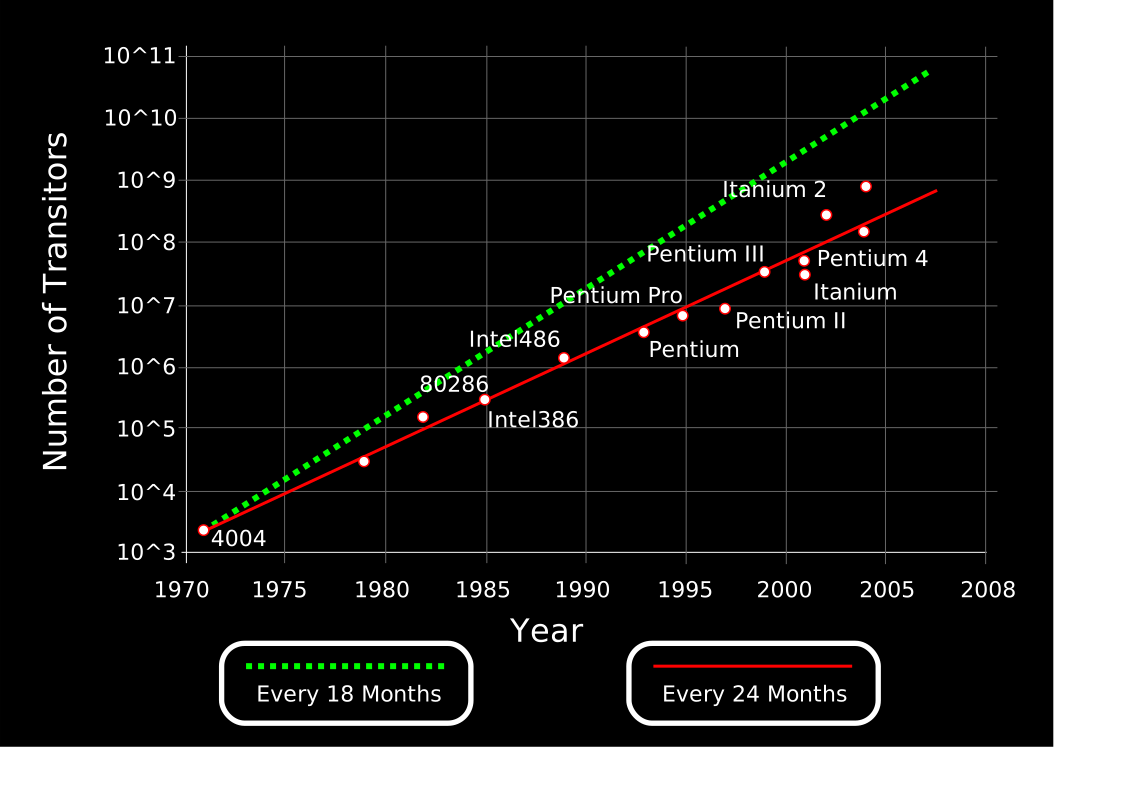
Black Background image showing Moore's Law

Moore’s Law (Photo credit: Wikipedia)

Three Months Circling the Future

Nigel Cameron is President of the Center for Policy on Emerging Technologies (C-PET), a Washington, DC think tank on technology and the future. He also blogs at FutureofBiz.org.

Two years ago I penned, or should I say keyboarded, a commentary with the title A Week in Tomorrow. It told the tale of three successive conferences. That will help explain the trope of the title. But I anticipate.

Midway through 2012, there are four big things on my mind. They should be on yours too. Not simply because in themselves they are in varying proportions significant and fascinating. But because if we are to start thinking straight about the future, in our companies and our government, here are the case studies to teach us. They are plain enough; the four dominant (non-defense) issues of this year. In no special order:


  • the Facebook IPO
  • the Presidential election
  • the Dragon spacecraft
  • and the global climate process, focused on Rio+20.


As some of you will know, I’ve touched on each of these before, both in newsletters and my blog posts (at c-pet.org, and FutureofBiz.org). Here, I’d like to look at them through the lens provided by the past three months of my travels. For fate, or le bon Dieu, depending on your predilection, determined that I would be invited to nine different conferences (to be pedantic, actually 11. I pulled out of one – on corporate social responsibility – as I was sick; and another, on the future of healthcare, got postponed). Of the 11, eight were in the United States, and three in Europe. (No repeat of 2010-11, when I managed to be invited to make a speech on each of the five inhabited continents. Let’s not get into the 46 hours and four flights it took me to get from Cape Town to Beijing, slowly recovering from, well, you can guess . . . . Great bio lines come at a price.)


A word about the issues. Facebook. When did America last flock to a movie about a start-up? Even Google, our ubiquitous info point, never got that. And when did Wall Street find itself confronted with a hoodie who was not trying to occupy it – and hand over very, very serious cash? The election. Rhetoric notwithstanding, Moore’s Law determines that every presidential election is in certain key respects more significant than the last – whatever our politics, and whatever the merit of the respective candidates. Dragon. Suffice to say that 50 years ago American got seriously interested in space, lost interest, and is coming to terms with the fact the next round is being catalyzed by private money and private leadership (and China). Then climate. I’m not here taking a view. But there are many more views than two, and according to all aside from one of them this issue is huge. And even that one should take out an insurance policy.


Now for the conferences. What interests me above all is that I don’t know anyone who was at more than one of them. Certainly, the nonofecta was mine alone. I was invited to all of them; to join the program at 6 and be a guest at the other 3. At the risk of convincing you I have a ridiculously wide range of interests, let me run through them. My presentations/moderations were at WorkTech (future of work; in NYC); the European Cloud and Identity conference in Munich (a 3-day marathon which I was invited to moderate after sharing the opening keynote); a conference on global education, my keynote being on resource-poor regions; Gov.2.0LA addressing the new accessibility of government in the digital age (and a chance to save democracy); Planet under Pressure, the global science gathering preparing for Rio+20, the UN process on climate change; and the Tech Policy Summit (an annual goodie, this time in Napa, which C-PET co-sponsored). I was also a guest at a conference of 1100 venture capitalists and entrepreneurs (MAVA, in DC); the Ideation conference, focused round social enterprise; and SOBcon, which gathers leaders in social marketing under the irresistible, almost ineffable, queen of blogging and much else besides, Liz Strauss.


If you’re counting, five of these events were business-focused, three on policy, and one on education. What all nine had in common was rapid technological innovation, and the shadow of the future. As conferences, they varied: from the intimacy of SOBcon, with every meal and a nightclub and karaoke together for just over 100; to 3,000+ at the climate event. Gov 2.0LA was smaller but had 100,000 following the webcast around the planet. MAVA was mostly pitches and updates from entrepreneurs; Ideation reports from social enterprise gurus and start-ups; WorkTech, a packed one-day event in NYC (they have other sites around the globe), that brought together Intel’s futurist and MIT’s Sherry Turkle with space planners and real estate leaders; in Munich I had the honor of presenting the European Cloud and Identity Awards to the likes of Daimler and Deutsche Bank (oh yes, and joining one of the famed Ping parties, hosted by its CEO who was still passing out shots when I left at 1.00 a.m.). And Planet under Pressure was dripping with Nobelists; most notably the great Elinor Ostrom, whom it was my special honor to meet for the first and, so sadly, last time (she passed a few weeks later).


Point is: There is a fundamental alignment between our thinking about the future, risk, business, social enterprise/CSR/nonprofits, innovation, and technology. Some examples from my personal mash-ups:

  • My argument on global education was that mobile had changed the “valuation” of resources now available to resource-poor nations, such that innovative solutions to education are now possible (that parallel the M-PESA banking revolution in Kenya).
  • On the Future of Work at WorkTech: That how we think about the future must powerfully determine how we act today (let’s not talk about how failure to address the future will doom it for you and your company).
  • To Gov2.0, that digital offers us our great (and urgent) opportunity to save democracy.
  • To Planet under Pressure: That a fundamental reframing of the climate debate in terms of global risk is needed, and that it must be led by industry and government leaders, not the scientists and NGOs of the parallel universe.
  • At the Munich cloud conference: inter alia, I moderated the discussion about cybersecurity, on which hangs a good deal of C21.
  • At Tech Policy Summit, the panel I moderated: What do we need for U.S. competitiveness?


That is to say: In each of these seemingly diverse contexts the imperative is to take the future more seriously; to bring the Moore’s-Law driven tech revolution into every conversation; to recognize that every single decision we take today is profoundly shaped by the assumptions we make about tomorrow. Value for business, and good policymaking for government, are dependent on a convergent conversation that spans every one of these seemingly disparate, silo’d conversations. The moreso every day.


Oh, and by the way: The most memorable, and perhaps most illuminating, response I received at any of these nine expert gatherings was at the event on global education, where a former senior official of the United Nations summed up my argument as “crap.” At least he was listening.


I trust you can see where we are going. My key point here is the connected nature of these discussions, the fundamental relevancy of each to the other. Our standard approaches to understanding, and its child decision-making, are revealed as threadbare because they are hopelessly silo’d. For, tragically, within these silos we have essentially distorted our capacity to prepare for continued exponential change. That is, we have insisted on defining the future in terms we find congenial. We bend the path of exponential change to ensure that we face a future that is thoroughly compatible with the present, rather than daring to think of one that mirrors the creative destruction of which we have learned from the deep discontinuities of the past.


Back to the case studies. Facebook? Well, many investors are treating it as if it were the next General Motors. Yet as a digital company its lifescycle will be foreshortened (the lifecycle of these digital companies will typically get faster); as one analyst has suggested, it may soon resemble Yahoo, a profitable enterprise yet with far lower value in the market. Discontinuities have powered the success of entrepreneur Elon Musk and his Dragon spacecraft, whose seemingly flawless first trip is just completed. The Presidential election is fielding two smart decent men (sorry, partisans; I have my own take but this much is obviously true), neither of whom (sorry, again) seems unduly, or even duly, preoccupied with the future. And the climate debate, now post the hyped and hopeless Rio+20, displays all the most expected naivety of the global NGO movement which honestly believe that their voices raised loud yet again will shape the thinking of corporate and government leaders. As I pointed out at Planet under Pressure, this debate is now running backwards. And as I have subsequently argued, it is crucial to reframe the discussion – in terms of global risk and in the context of other clamant risk issues, from rabid nanobots to WMDs to the prospect of post-antibiotic medicine to security asymmetries (especially cyber-risk) – if decision-makers in finance, business and government are to take it seriously. The fulminations of scientists and left-leaning NGOs have only so much impact, and it can be net negative.

Some tentative conclusions

Three practical proposals

  1. In every discussion of strategy, include a futures advocate whose task it is to stand 10 years out and raise hard questions.
  2. In every discussion of strategy, include outlier opinion from today. As far out as you can find. All articulate voices. Seriously. In 1. and 2., protect that person with the authority of the Board Chair/Head of State. Indefinitely.
  3. Work with your team, not once but repeatedly, on what the E-word means. Exponential. It has become the most important word in the vocabulary. At every strategy meeting begin with a discussion/reflection/meditation on what are its implications for your business. Every.


Major newspapers have lately appointed “Public Editors” to speak from the outside and act as ombudsmen. How about every company, department of state, NGO, appointing a Public Discussant, whose task it is – at the most senior level – to raised the hard long-term issues, and ensure that groupthink is shot at if not down?


The issue is not, let it be said, about technology. Technologies become the vehicle for and catalyst of dramatic change. Change is the point. Change and the fact that we cannot prepare for it by being good at the things we used to be good at, in the way in which we used to be good at them. Exponential change operates at a visceral level. Take a look at what has happened and is happening to newspapers, and to book publishing. That’s the impact of exponential change. Its effects will be felt in every area of the economy and most areas of social and political life. Those effects have only begun to engage.


Let’s suggest Three Draft Laws of Exponential Change

  1. We are required to make faster and more far-reaching decisions; all the time. Alvin Toffler’s famous book Future Shock, published a generation ago, essentially made this argument though long before its implications were as dramatic as they are today.
  2. Each year is shorter than the last. At the International Content Summit last year I suggested that organizations revamp their schedule to gather sooner each time they met. The year is shortening. Time to add a touch of geometric progression to the Gregorian calendar?
  3. Competitive advantage lies with companies, nations, and individuals who are nimble, flexible, and integrated.


So as we value Facebook, anticipate space policy, reflect on issues of global risk, and prepare in the United States for a presidential election – and as in our companies and organizations we work through our own plans for strategy and tomorrow – this is the way we shall need to go. In a context in which the only issue from the future deeply concerning this nation, the deficit, is an issue from the past; and in which recent  research revealed only a tiny handful of CIOs from our major companies personally engaged in social media; the only way would seem to be up. Let’s go.


The Future and Us and Kurzweil

Ray Kurzweil at Stanford Singularity Summit.

Ray Kurzweil at Stanford Singularity Summit. (Photo credit: Wikipedia)

Ray Kurzweil is one of around a dozen figures who mark out the space between present and future – and us and technologies. He is an optimist as to speed of progress and its generally beneficent character, up to and including his “singularity.” Here he is noting, in general rather helpfully, that the future is easier to predict than some may think, in areas where exponential digital change is driving events (if you like, on Gordon Moore‘s moors.)

Of course the fun really starts when technologies bump into each other (convergence), when their disruptive impact is so great it’s just not clear what’s going to happen next, when people (yay, people!) decide to make decisions that shape what comes next, and so on.

I’ve written before about various aspects of all this (not least the rapid aging of companies that are out there on Moore’s moors – segue to Facebook‘s valuation, and so on). It’s handy to be reminded of the impact of the digital factor. Perhaps we can devise an impact factor that could be attached to companies, business models, and industries. Those close to pure digital will flourish rapidly and collapse/be superseded very fast. The search/social phalanx is slowly being followed by biotechnology as digitization and the management of huge data sets moves along (and, oh yes, typewriters and sliderules . . .). Random industries such as travel agency and cameras (sorry, Kodak) were hit hard and early. Publishing has taken longer and is going through an anguished process that will not soon be resolved. Education, especially higher education, has resisted with a fortitude and insouciance that would have been hard to resist.

So yes, some things are easier to predict. Some much less so. Some will always surprise. And then there’s the human factor.

Ray Kurzweil on Predicting the Future #WIFNY | Working Knowledge ®.

Social Media is NOT necessary for the C-Suite . . .?

English: Infographic on how Social Media are b...

English: Infographic on how Social Media are being used, and how everything is changed by them. (Photo credit: Wikipedia)

After all the recent talk around the unbelievably low numbers for executive participation in social media – including that of hardly any CIOs, which should be a hanging offence if not one for drawing and quartering first – we now have an effort to defend the C Suite and pooh-pooh the concerns of those of us who have been suggesting that the Fortune XXX are well on their way to losing their fortunes.

Jeff Esposito makes the best of a thoroughly bad case, and I invite you to read it (link below).

Quick points in rejoinder (and see my earlier posts):

1. The issue is strategic. If in 2012 hardly a soul in the C-Suite is actively engaged in social, a (the?) major source of competitive (dis)advantage is simply being ignored – because, unlike say the dictaphone, you don’t know what you’re talking about / hiring for /strategizing about unless you have splashed around with several of these platforms over time. As I said in an earlier post, social is like saying you’re sorry; you can’t just hire someone to do it for you.

2. CEO disengagement is bizarre (these are supposed to be the smart guys). @Rupertmurdoch stands out as the only top CEO using Twitter interestingly. Only. But if the CIO, the conscience of the new info technology, is making snide remarks about people wasting their time “twittering,” it is not surprise everyone else in the suite feels they are off the hook. He (OK, almost all of them are) is doing more damage to the company than he could begin to imagine. At Moore’s Law speed, the social revolution is – chaotically – up and running. (The fact that most U.S. CIOs still report through the CFO, another body blow revealed by recent reseach, explains, sadly, a lot.)

3. Point is: This is not “about” marketing/customer service – though fielding complaints in real time is no bad thing. It’s about strategic re-invention by the alignment of corporate values, the values of employees, and those of present and prospective customers. It’s about B2B as much as B2C. It’s about letting loose a force for continuous innovation within the company – the only way, in the M’s-Law context, that this can be achieved. This is nuclear stuff. And the sooner 225 CIOs are giving their marching order (only 25 are on Twitter), the better. At least, if shareholders and boards have any interest in long-term profitability.

Jeff’s charge is partly that social media pros, whatever exactly they are, are jumping up and down about a situation which is of course of interest to them. But by and large their interests are tactical and marketing/CR focused. This issue is nuclear in its implications. There is no better thing any board member or CEO or C Anything Else could do than spend 2 weeks in social media immersion.

Memo to Social Media Pros – Social Media is NOT necessary for the C-suite.

China’s Xiaomi Declares War on Apple

Aside

As we move around inside and occasionally comment from the outside of the US technobubble, it’s handy to peak into another country that could just get serious about what we have been so good at. And we all know where that is.

This neat piece drills down deep into Xiaomi, recently valued at $4bn after its Series C; its ex-MS and Google leaders; and its plan to go head-head with you-know-who(m) initially in the vast expanse of the China market.

A sobering read. And exciting.


Already Valued at $4B, China’s Xiaomi Has Declared War on Apple | PandoDaily.

The Grim Details on CEOs and Social; 14/500 are tweeting, for example

An Evening with the Fortune 500, May 7, 2012

An Evening with the Fortune 500, May 7, 2012 (Photo credit: Fortune Live Media)

I am rapidly coming to the conclusion, as these bizarre studies keep tumbling in, that serious personal engagement in social media is an absolute prerequisite for corporate leadership in 2012. And given the numbers, it’s also the single biggest opportunity for developing competitive advantage.

And here’s a project – anyone want to team up? Remedial social education camp: Every Fortune 500 CEO and other C-Suite denizen, every member of their boards, unless they are in the tiny minority actively and seriously engaged, needs to come spend a week being enabled to understand the single most dynamic force in the world in which they are operating.

Here are some of the most telling numbers.

  • 5 of the 19 CEOs on Twitter have never tweeted, and other accounts are “underutilized”
  • 25 of the 38 CEOs on Facebook have less than 100 friends
  • only four CEOs are on Google+ (including Larry Page)
  • not a single Fortune 500 CEO is on Pinterest

Here’s the report. Pour yourself a stiff drink before opening.

http://www.ceo.com/wp-content/themes/ceo/assets/F500-Social-CEO-Index.pdf